 Save
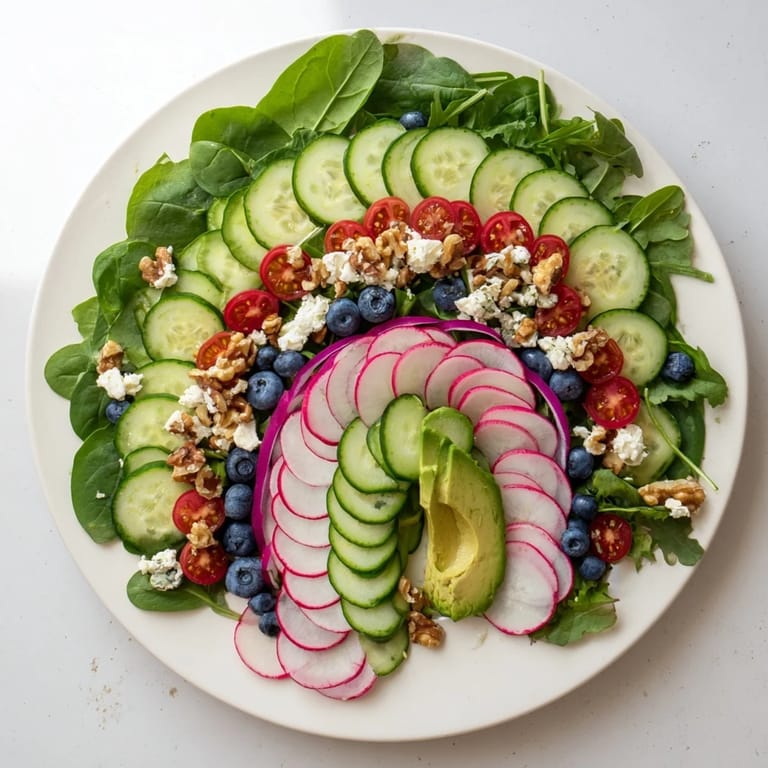
Save I discovered the Fibonacci Fan Salad while watching my friend arrange vegetables on a plate with almost mathematical precision, and something clicked. She wasn't just making dinner; she was creating art that happened to be delicious. The way ingredients spiraled outward, each section growing larger than the last, reminded me that the most beautiful meals often follow nature's own patterns. That night, I realized a salad could be as much about how it looked as how it tasted, and that one revelation changed everything about the way I approach the dinner table.
The first time I made this for guests, someone asked if I'd taken a class in food styling, and I nearly laughed because it's genuinely easier than it looks. What surprised me most was how everyone slowed down to eat it, actually paying attention to the flavors instead of rushing through. That moment taught me that presentation isn't pretentious; it's an invitation to care a little more about what's on your plate.
Ingredients
- Baby spinach leaves: The foundation of your spiral, tender and mild enough not to fight with the bright flavors coming next.
- Arugula: Its peppery bite is what keeps this salad from being too delicate, adding personality without overwhelming.
- Cherry tomatoes: Halved so they nestle into the spiral and release just a hint of juice when you bite them.
- Cucumber: Keep your slices thin and consistent; they should almost feel translucent when held to the light.
- Radishes: These paper-thin slices add a sharp, slightly sweet crunch that makes people pause mid-bite.
- Red onion: Finely sliced so it doesn't overpower but instead acts as a flavor bridge between sections.
- Avocado: Choose one that yields slightly to pressure but isn't mushy; slice it just before assembling to prevent browning.
- Blueberries: They're the small surprise tucked throughout, adding sweetness and color contrast.
- Toasted walnuts: Toast them yourself if you can; the difference between pre-toasted and fresh-toasted is worth those five minutes.
- Feta cheese: Crumble it with your fingers for irregular pieces that catch the dressing better than uniform chunks.
- Extra-virgin olive oil: This is not the place to use cooking oil; quality matters when it's one of only a few elements.
- Lemon juice: Fresh squeezed makes a noticeable difference in brightness and prevents that bottled tang.
- Honey: Just enough to balance the acidity without making it sweet; trust the small amount.
- Dijon mustard: The secret ingredient that brings everything into focus without announcing itself.
Tired of Takeout? 🥡
Get 10 meals you can make faster than delivery arrives. Seriously.
One email. No spam. Unsubscribe anytime.
Instructions
- Start with spinach in a crescent:
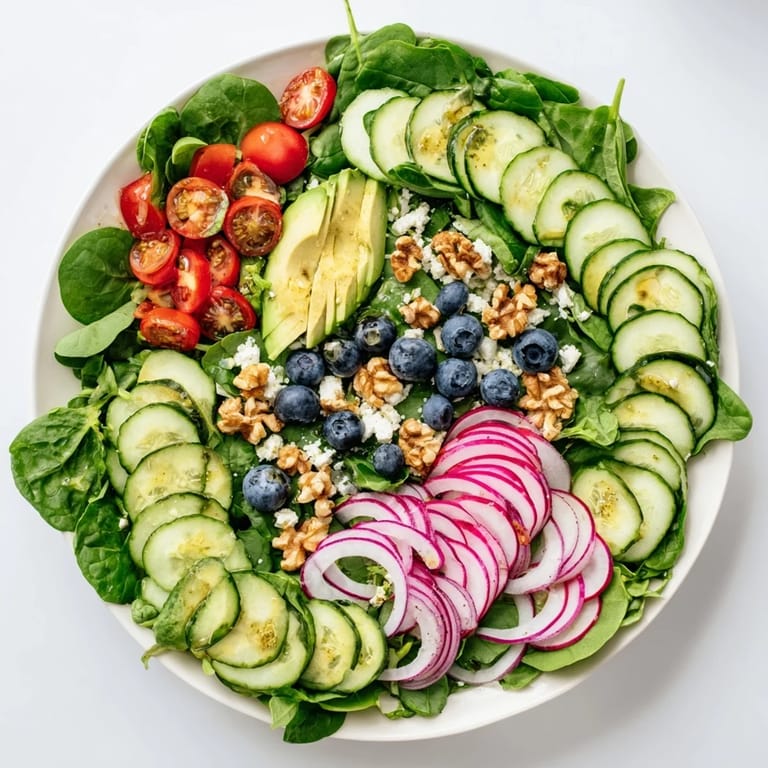
- Arrange your baby spinach on a large round platter in a gentle arc, like the opening of a spiral. Think loose and organic rather than rigid; this isn't a geometry lesson, it's the beginning of a pattern.
- Layer arugula as your second ring:
- Overlap the arugula slightly onto the spinach, expanding outward just enough that you can see both greens. The peppery leaves should fan out like they're naturally growing larger.
- Build the middle sections with tomatoes, cucumber, and radishes:
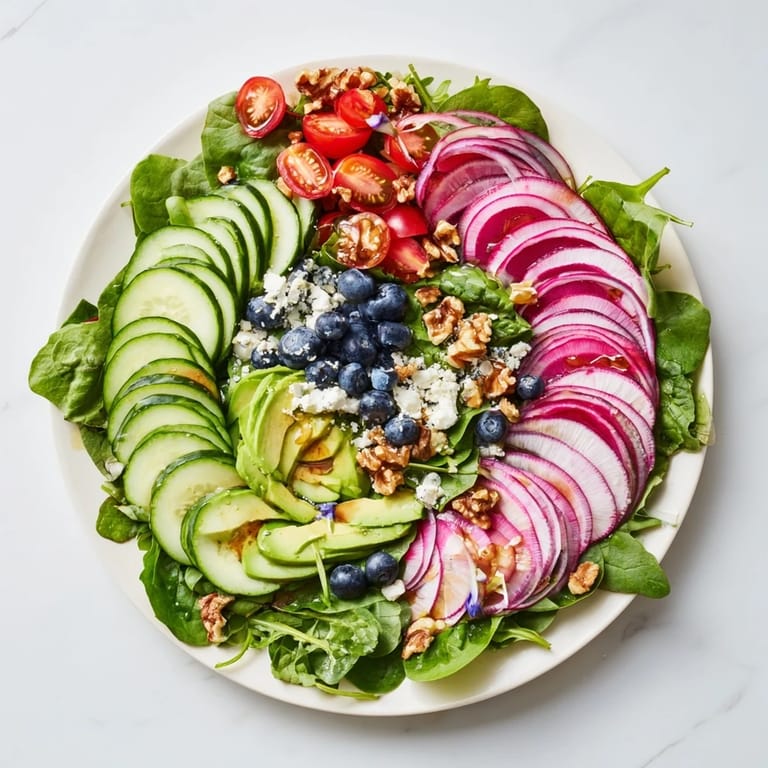
- Continue adding each element in expanding arcs, each ring slightly bigger than the last. Watch how the vegetables naturally follow the spiral ratio if you let them; you don't need to measure, just trust your eye.
- Add red onion as an accent ring:
- Place thin red onion slices near the outer edge where they'll be visible but won't overpower the center. These become the frame that holds everything else.
- Tuck avocado and blueberries throughout:
- Nestle these elements into the spiral where there are small gaps, letting them break up the visual rhythm. They're the jewels that catch the light and make people lean in.
- Top with walnuts and feta:
- Sprinkle both across the entire salad so every section gets some of both. The texture and richness tie the whole arrangement together.
- Whisk your dressing:
- In a small bowl, combine olive oil, lemon juice, honey, and Dijon mustard, whisking until it emulsifies slightly. Season with salt and pepper, tasting as you go because every palate is different.
- Dress just before serving:
- Drizzle the dressing in a thin stream across the salad, letting it pool slightly in the center. This is the moment right before everyone digs in, when it looks its absolute best.
 Save
Save What struck me most after making this several times is that it became a conversation starter in a way regular food never was. People genuinely wanted to know why it was arranged that way, what the spiral meant, and suddenly we were talking about math and nature and beauty—all while eating vegetables. That's when I knew this wasn't just a salad recipe; it was an excuse to slow down.
The Spiral Principle
The Fibonacci sequence appears everywhere in nature—sunflower seeds, pinecones, galaxies—and when you apply it to food, something magical happens. You don't need to be a mathematician to use this principle; your eye will guide you toward proportions that feel balanced. The beauty is that there's no single correct way to arrange it, which means even if you've made this five times, the sixth will feel fresh because you'll choose slightly different placements based on how your ingredients look that day.
Playing with Substitutions
This salad is forgiving in the best way because the structure is flexible. I've made versions with goat cheese instead of feta, added crispy chickpeas for protein, swapped the blueberries for pomegranate seeds when they were in season, and every version worked beautifully. The spiral pattern absorbs whatever you add because the arrangement is what makes it special, not the exact ingredients you choose.
Making It a Meal
On its own, this salad is a light, refreshing course or a perfect lunch when you want something that feels nourishing without being heavy. But it also works as the foundation for something more substantial when you're feeding a crowd or want dinner to feel more complete. Adding grilled chicken, crispy tofu, or a handful of warm chickpeas transforms it into a main course without losing any of its visual appeal.
- Grilled chicken sliced and arranged along one outer section creates beautiful color contrast and adds lean protein.
- Warm chickpeas tossed in a bit of extra dressing and scattered across the top bring earthiness and texture.
- Don't add protein until just before serving, or it will warm the greens and affect the final presentation.
 Save
Save There's something deeply satisfying about arranging this salad—it slows you down in a world that moves too fast. Every time I make it, I remember why I fell in love with cooking in the first place: not because it was complicated, but because it gave me permission to pay attention to small, beautiful things.
Common Questions
- → What is the Fibonacci concept used in this salad?
The ingredients are arranged in expanding arcs following the Fibonacci spiral, creating a balanced and visually appealing presentation.
- → Can I substitute feta cheese with another type?
Yes, goat cheese or other crumbly cheeses can be used as alternatives to feta for a different flavor profile.
- → How should the dressing be applied?
Whisk the olive oil, lemon juice, honey, Dijon mustard, salt, and pepper together, then drizzle evenly over the arranged salad just before serving.
- → Is it possible to add protein to this dish?
Yes, topping with grilled chicken or chickpeas provides additional protein while maintaining freshness.
- → What are key tools needed for preparation?
A large round platter for arranging, a chefs knife and cutting board for slicing, and a small bowl with a whisk to mix the dressing are necessary.